What to expect inside Freetown Christiania
The first ten minutes
You come in through a wooden gate on Prinsessegade with the community’s rules posted on it. The first thing you notice is what is missing. Christiania is pedestrian and bicycle only, so the loudest sounds on a weekday are a bike bell, a radio in an open workshop and somebody’s dog. I fixed cargo trikes two streets from that gate for nine years and the drop in volume when you step through it still registers.
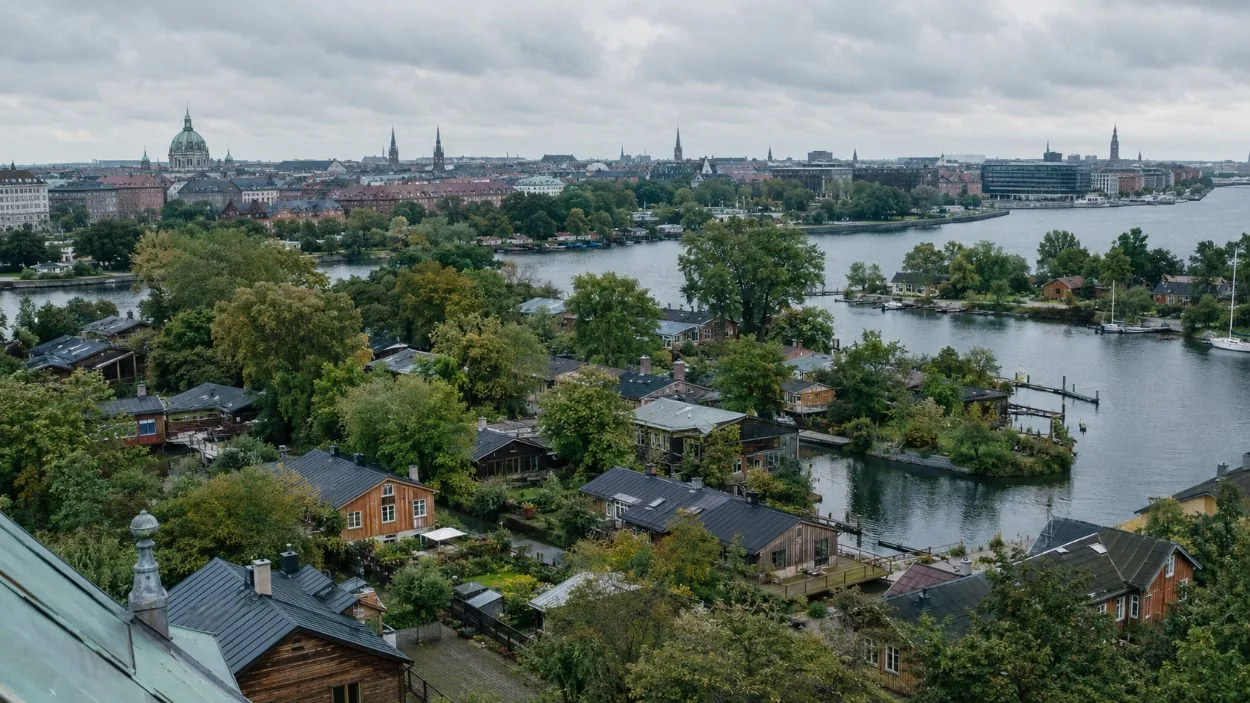
The second thing you notice is that the buildings are not uniform. People built these houses by hand from the 1970s onwards and they still live in them, so you get a shed roof next to a glasshouse next to something with a turret, all of it maintained by whoever lives there. It reads as improvised because it was.
The scale is smaller than the map suggests
Thirty-four hectares sounds large, and it includes the old defensive ramparts and the Stadsgraven moat wrapped around them. The built part — the bit with cafés, galleries and the Grey Hall — is a fraction of that. You can walk the busy end in fifteen minutes. The ramparts and the lake take longer and are the half most visitors miss; I have put the order I walk them in on the things to see page.
What it is not
It is not a theme park and it is not a permanent street party. About half a million people a year come through, which is a lot of feet for a place where roughly a thousand people are trying to have an ordinary Tuesday. The paths between houses are somebody’s drive rather than a route, and that single idea covers most of the rules and etiquette you need.
It is also not the place described in guidebooks written before 2024. The trade that gave Christiania its reputation is gone, and what stands on that stretch now is an ordinary paved walkway. The Pusher Street page has the full sequence of how that happened.
What works
- No cars, so the whole area moves at walking pace
- The ramparts and the lake are green, quiet and open at any hour
- Workshops, the Grey Hall and Loppen are all within a short walk of the gate
- Nothing is staged for visitors, which is the point of coming
Worth knowing
- People live here; front gardens and private drives look like public paths
- Cafés, galleries and workshops open later in the morning, roughly from 10–11am
- Photography has limits — ask before pointing a lens at anyone
- Do not run. It reads as trouble here, for historical reasons
Come in through the main gate on Prinsessegade rather than wandering in from the ramparts. The rules are posted at the gate, and reading them takes thirty seconds and saves you from the two or three mistakes visitors make most often.
What a guide changes
Without one you will photograph a mural you cannot read and walk past three things that matter. A guide tells you who painted the wall, which gravel track is a private drive and where the camera stays in the bag. The two-hour Christiania and Christianshavn walk is the one most people book, and it pairs the Freetown with the Church of Our Saviour and the Opera House. If you would rather go in alone, read guided versus self-guided first.
Frequently asked questions
Is Freetown Christiania open to the public?
Yes. The streets are open at all hours because it is a residential district, and there is no ticket or entrance charge — see do you need a ticket. The cafés, galleries and workshops open later in the morning, roughly from 10–11am.
How long should I plan for a first visit?
An hour covers the built centre; two hours lets you add the ramparts and the lake without rushing. The how long to spend page breaks down what each option actually buys you.
What surprises visitors most?
The quiet, and the fact that it is somebody’s home rather than an attraction. The second surprise is usually how ordinary the old Pusher Street stretch looks now — the residents dug the cobblestones up on 6 April 2024.